
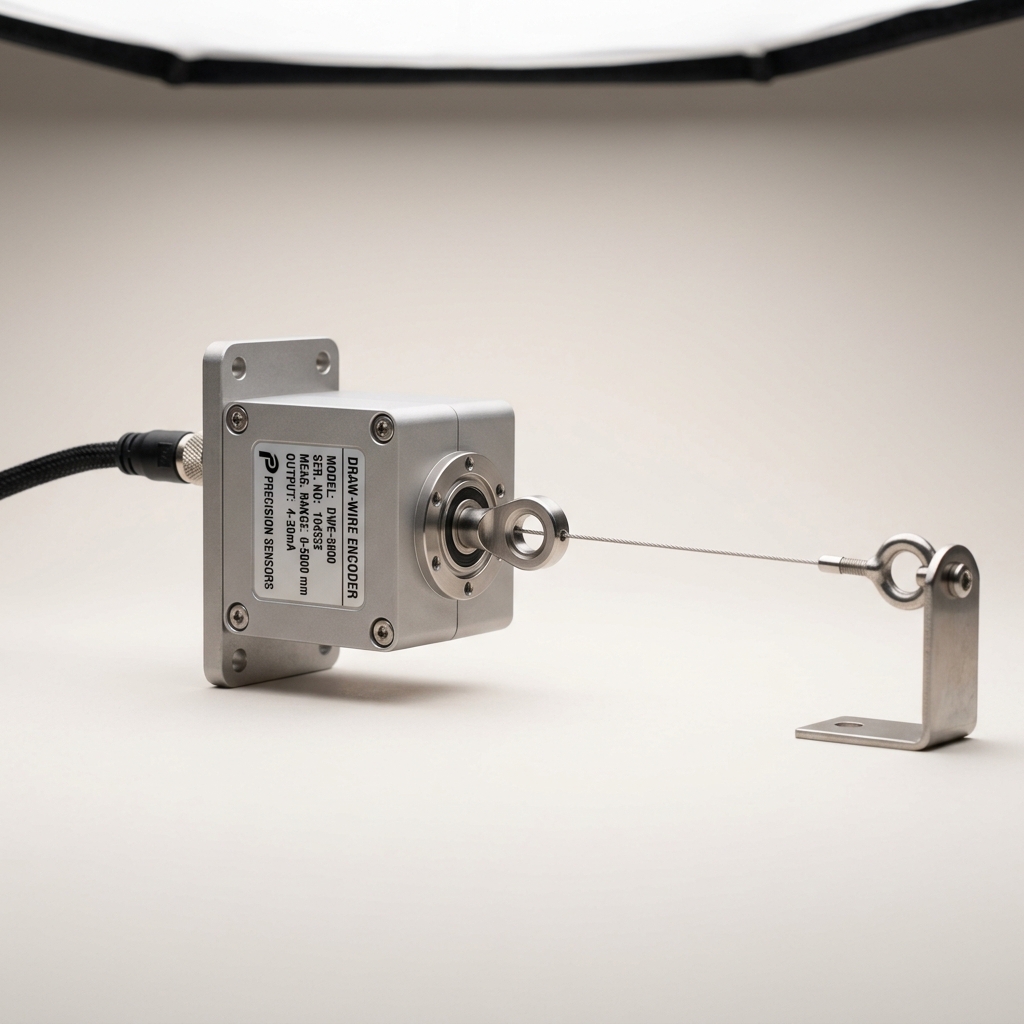
Draw-wire and wire-actuated encoders convert linear travel into reliable position feedback in a compact, direct package. Sensor Measurement is the official TR Electronic Australia representative, offering local sales and technical support for wire-actuated encoder applications across Australia and New Zealand from our Perth base.
Draw-wire encoder technology
Linear travel feedback, in a compact footprint.
Wire-actuated encoders - also called draw-wire or string-pot encoders - measure linear displacement by winding a measuring cable onto a drum that drives an rotary encoder element. As the moving machine component pulls the cable out, the encoder reports the corresponding linear position or speed.
Because the measuring cable can reach over long linear distances while the encoder body stays compact and fixed, wire-actuated encoders suit applications where a full linear scale would be bulky or hard to mount. They are commonly used to measure moving machine sections, lifting travel, boom extension and carriage position, providing direct feedback on the displacement of a moving part.
A wire-actuated encoder measures linear travel by drawing a measuring cable from a drum, giving compact position feedback for moving machine components.
Selection guidance
Specifying a wire-actuated encoder.
Choosing a draw-wire encoder comes down to the travel range, how the cable routes to the moving part, the mounting interface, the signal your controller expects, and the environment it will live in. Use these points as a starting point and talk to our team for application-specific advice.
Travel range & measurement length
Confirm the full linear travel the moving part will cover, then choose a draw-wire encoder whose measuring range comfortably exceeds that travel so the cable never reaches full extension.
Allow headroom for overshoot or positioning tolerance so the cable drum is not pulled to its mechanical limit during normal operation.
For very long linear travel, consider a draw-wire principle rather than a rotary encoder plus rack-and-pinion, as it keeps the feedback path compact and direct.
Cable routing & exit geometry
Plan the cable path so the wire exits and retracts in a straight line to the moving attachment point, avoiding angular misalignment that accelerates cable wear.
Keep the cable clear of pinch points, hot surfaces and moving structure that could foul or abrade it over the duty cycle.
Where the attachment point moves on an arc, confirm the permissible cable exit angle so the drum guidance remains reliable.
Mounting & mechanical interface
Select a housing and mounting footprint that fits the available space on the machine frame or structure, including the fixed and moving anchor points.
Verify the fixing method - flange, foot or bracket - suits the installation and allows service access.
Consider whether a compact draw-wire unit can replace a longer linear scale or tape where installation space is limited.
Required signal & output
Match the output to your controller: incremental pulse for speed and counting, or absolute position that survives a power loss without re-homing.
Confirm the interface - such as SSI, fieldbus or analogue - is compatible with the existing control system and cable run.
Decide whether single-turn position over the cable travel is sufficient, or whether total accumulated travel also needs to be tracked.
Operating environment
Account for dust, moisture, washdown, vibration or temperature extremes that may require a sealed or ruggedised housing.
On mobile plant and outdoor equipment, consider the impact of shock, contamination and weather exposure on cable and drum life.
For hazardous areas, confirm the encoder is rated for the required zone rather than assuming a standard industrial housing is suitable.
Applications
Where wire-actuated encoders fit.
Wire-actuated encoders are used wherever a moving machine component needs direct linear position feedback but the space or geometry makes a linear scale impractical. Typical uses include:
Lifting equipment
Draw-wire encoders provide linear position feedback on hoists, cranes and lifting platforms where the cable travel directly follows the raised load, giving a compact feedback path without a separate linear scale.
Mobile plant
On mobile machinery, wire-actuated encoders monitor boom extension, steering or deck position where space is tight and the environment is exposed, giving reliable linear feedback in a small footprint.
Warehousing systems
In automated storage and retrieval, conveyors and shuttle systems, draw-wire encoders track carriage and elevator position over the travel length, supporting positioning control across the aisle or rack height.
Moving machine sections
Wire-actuated encoders measure the displacement of slides, tables, doors and adjustable machine sections where a direct linear signal is preferred and the cable can follow the moving component.
For applications that need pure rotary feedback rather than linear travel, see our rotary encoders and linear encoders pages for alternative positioning technology.
Local support
Backed locally, across the region.
As the official TR Electronic Australia representative, Sensor Measurement provides local sales and technical support for wire-actuated and draw-wire encoder applications throughout Australia and New Zealand. From selection guidance through to ongoing support, we help ensure the linear feedback technology you choose is right for your application and conditions.
Application guidance to match the right draw-wire encoder to your travel and mounting.
Local technical support from our Perth-based engineering team.
Tell us about your application and travel requirements, and our team will help you identify the right draw-wire or wire-actuated encoder solution for your conditions.