
Western Australian owned since 1988Technical support & enquiries

Absolute position feedback

Absolute Rotary Encoder Australia.

Absolute rotary encoders report true shaft position the moment power is applied, so an axis never has to be driven to a reference mark before the control can trust it. Sensor Measurement supplies and supports single-turn and multi-turn absolute encoders from TR Electronic across Australia and New Zealand, with application advice from our Perth-based team.

What it does

Position you can trust
at switch-on.

An absolute rotary encoder assigns a unique code to every shaft position and reads that code optically or magnetically. The value is available as soon as the encoder has power, which removes the homing move that an incremental encoder needs after every stop, power failure or emergency condition.

Because each position has its own code, a missed edge or an electrical disturbance cannot quietly shift the reference the way it can with a pulse train. The control either reads a valid position or it reads a fault, which is why absolute feedback is common on safety-related and multi-axis machinery.

Single-turn devices report position within one revolution. Multi-turn devices also count revolutions, so total travel is retained over long axes, geared drives and lifting equipment.

Types we supply

Single-turn, multi-turn
and heavy-duty.

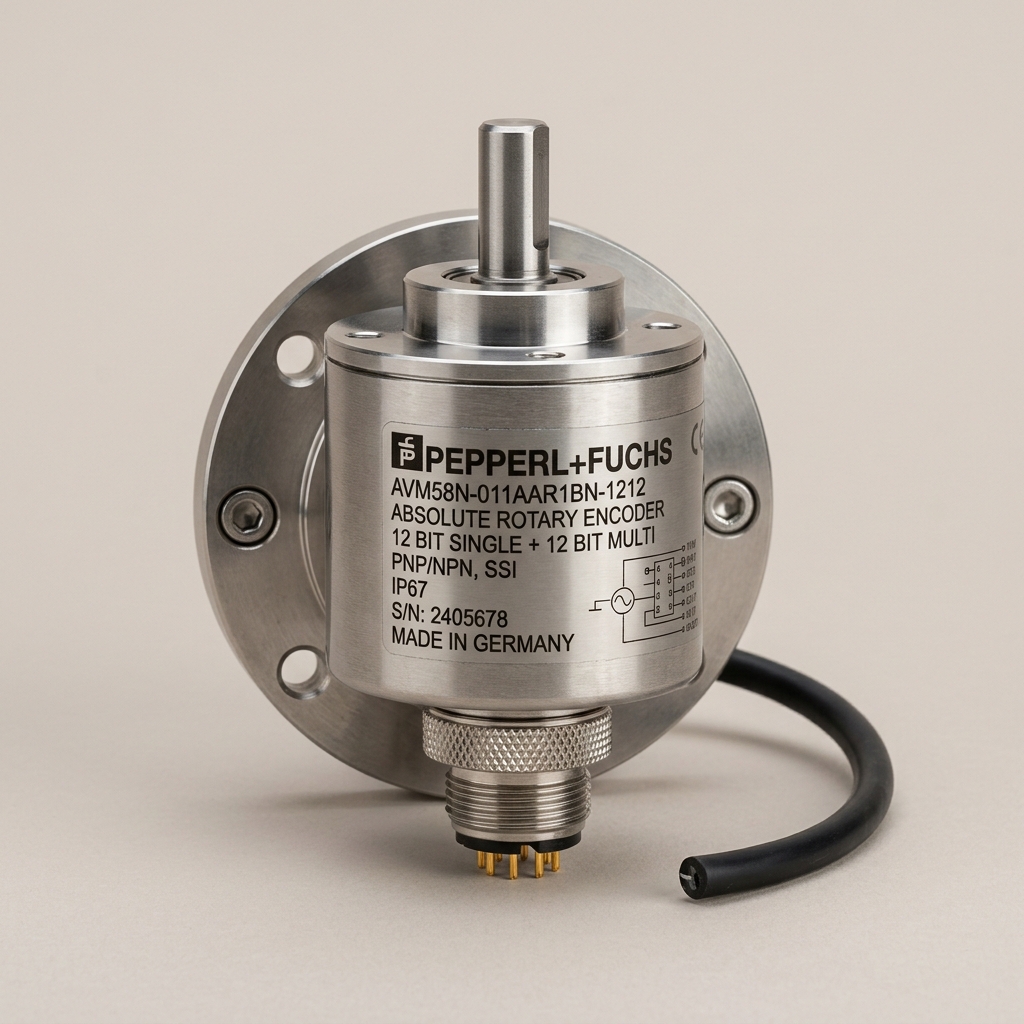
TR Electronic single-turn absolute rotary encoder with clamping flange

Single-turn absolute encoders

Single-turn absolute encoders report an unambiguous position value for one full revolution of the shaft. Position is available immediately at power-up, so the axis never needs to be driven to a reference mark before the control can trust its reading.
TR Electronic multi-turn absolute rotary encoder in an industrial housing

Multi-turn absolute encoders

Multi-turn absolute encoders keep counting revolutions as well as the position within a revolution, so total travel is retained across a power cycle. This suits long-travel axes, geared drives, cranes and lifting equipment where a homing routine is impractical.

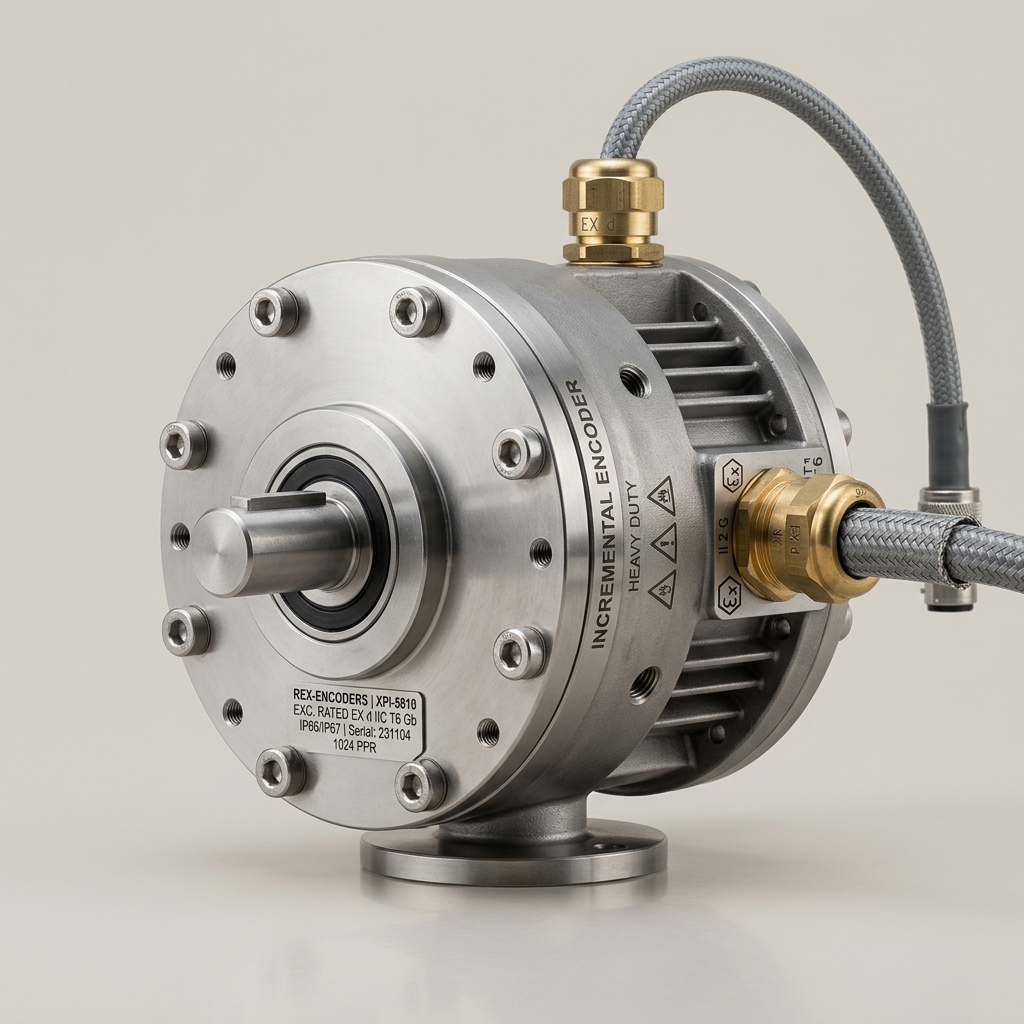
Heavy-duty absolute rotary encoder sealed for washdown and vibration

Absolute encoders for harsh conditions

Heavy-duty absolute encoders use sealed housings, robust bearings and wide temperature ratings for washdown, vibration, dust and outdoor plant. Versions with higher protection classes and stainless housings are selected where contamination or cleaning is routine.

Interfaces

Matching your control platform.

The encoder has to speak the language of the drive, PLC or motion controller already on the machine. We confirm the exact variant against your hardware before an order is placed.

Fieldbus and industrial Ethernet

PROFIBUS, PROFINET, EtherCAT, EtherNet/IP, CANopen and Modbus variants let the encoder sit directly on the machine network, with position, speed and diagnostics read as process data rather than pulses.

Serial and synchronous serial

SSI and BiSS-C remain the standard choice where a controller or drive expects a fast, deterministic position word. They are simple to diagnose and are widely supported by motion controllers.

Analogue and incremental-style outputs

Some applications need an analogue position signal or a pulse output from an absolute device. These variants let an older control platform gain absolute feedback without a full controller upgrade.

Selection checklist

Six things that
decide the model.

Bring these details to a conversation with our team and the shortlist usually narrows quickly.

  • Whether the axis must know its true position immediately after power loss, which rules out incremental feedback.
  • Single-turn or multi-turn: how many shaft revolutions the axis travels between the reference and the working position.
  • Resolution and accuracy required by the control loop, not simply the highest resolution available.
  • Interface expected by the drive or PLC, plus the cable length, connector type and cable route on the machine.
  • Shaft or hollow-shaft mounting, flange pattern, and the space available around the axis.
  • Environmental conditions: washdown, coolant, dust, vibration, ambient temperature and any hazardous-area requirement.

Typical applications

Where absolute feedback pays off.

Press brakes and forming

Absolute feedback keeps ram and backgauge position known at every power-up, which matters for repeatable bend depth and for guarding systems that rely on measured position.

Cranes, hoists and lifting

Multi-turn absolute encoders track hook height and travel without limit switches or homing runs, and retain that position through shutdowns and power interruptions.

Machine tools and linear axes

Absolute rotary encoders paired with a rack, belt or screw provide position feedback for slides, tool changers and rotary tables where re-referencing costs cycle time.

Valve, damper and actuator positioning

Absolute position is available on start-up, so actuators move to the commanded position without first searching for an end stop.

Winders, web and packaging lines

Position, speed and direction come from one device, with the absolute value available to the control after a stop or an emergency condition.

Mobile and outdoor plant

Sealed absolute encoders with wide temperature ranges and robust bearings suit equipment exposed to weather, vibration and washdown.

Comparison

Absolute or incremental?

Both are rotary encoders, and both are right for different jobs. The deciding question is whether the machine can afford to re-reference its axis after every stop.

Absolute rotary encoders

  • Position is known immediately at power-up, with no homing cycle.
  • A unique value is reported for every position, so a missed pulse does not silently shift the reference.
  • Multi-turn versions retain total travel across power cycles.
  • Higher cost per unit, offset by shorter start-up sequences and fewer position faults.

Incremental rotary encoders

  • Pulse output gives speed, direction and counting feedback at lower cost.
  • The axis must be referenced to a home position after every power-up.
  • Electrical noise or a lost pulse can shift the reference without an obvious alarm.
  • Well suited to rate measurement, length counting and simple closed-loop control.

Still comparing types? The rotary encoders Australia page covers the full range, and the incremental encoders page goes deeper on pulse-based feedback.

Ready to talk?

Tell us about
your axis.

Send through the controller, mounting, travel and environment and our team will come back with a suitable absolute encoder option.

Contact the team